How to Hire a Commercial Office Cleaning Service in 5 Steps
To hire a commercial office cleaning service , write down exactly what you need cleaned and how often, shortlist licensed and insured local providers, compare quotes built on the same scope, interview your finalists with questions that test how the crew actually works, and start with a trial period and a written scorecard. Do those five things in order and you will know what you are paying for before the first night of service.
Most office cleaning contracts go wrong for ordinary reasons. The scope is vague, so one bid covers restrooms and trash while another quietly includes vacuuming and breakroom care. The quotes show a monthly number with no hours behind it, so you cannot tell a fair price from a thin one. Then the crew changes, nobody checks the work, and you find out about it from an irritated tenant or employee.
This guide walks through the process one step at a time, with templates you can copy and a worked pricing example. It draws on how commercial cleaning is done in offices, clinics, and municipal buildings across Sacramento, Woodland, Rancho Cordova, Folsom, Davis, Roseville, and West Sacramento. By the end you will be able to run the hiring process yourself and spot a weak provider quickly.
What a commercial office cleaning service includes
A commercial office cleaning service covers the recurring upkeep of a workplace: trash removal, vacuuming, restroom sanitation, breakroom care, and high-touch surface disinfecting, performed on a set schedule. Heavier jobs such as floor refinishing and exterior window washing are usually separate line items.
What routine service covers
Routine service is the work that has to happen every visit or every week so the office stays presentable and sanitary. Daily or nightly tasks protect health and first impressions. Weekly and periodic tasks keep dust, buildup, and wear from compounding. The table below shows a typical split, which you should adjust to your building.
| Task | Typical frequency |
|---|---|
| Empty trash and recycling | Every visit |
| Clean and disinfect restrooms, restock supplies | Every visit |
| Vacuum carpets and mop hard floors in high-traffic areas | Every visit |
| Wipe breakroom counters, sinks, and appliance exteriors | Every visit |
| Disinfect door handles, light switches, shared equipment | Every visit |
| Dust desks, ledges, vents, and shelving | Weekly |
| Spot-clean interior glass and partitions | Weekly |
| Full-floor vacuuming and detailed mopping | Weekly |
| Strip, wax, or buff hard floors | Periodic, as traffic demands |
| Exterior window washing | Periodic, often quarterly |
A good scope tells the crew what to do every visit, what to do weekly, and what to do only now and then.
What usually costs extra
Providers typically quote the routine package first and price specialty work separately. Floor care is the biggest example. Sacramento Cleaning Services LLC, for instance, lists buffing, stripping, waxing, and mopping as its floor care techniques, and these are scheduled projects, not nightly chores. Window washing is another add-on, and the same goes for day porter coverage, where a staff member stays on site during business hours to handle restrooms, spills, and lobbies. Dust and pollen from the Sacramento Valley's long dry season and mud tracked in during winter rains make entry flooring and glass wear faster than many managers expect, so ask about them early.
In-house cleaning versus a contractor
Hiring a service instead of assigning cleaning to your own staff is mostly a question of accountability and coverage . A contractor brings trained crews, equipment, chemicals, supplies, and a replacement when someone is out. In-house cleaning means you manage payroll, supplies, training, and sick days yourself. For a small office that wants predictable results and one phone number to call, outsourcing is usually the simpler path, and the rest of this guide assumes you are heading there.
Step 1. Define your scope and schedule
Before you contact anyone, decide what needs cleaning, how often, and during which hours. Providers can only bid accurately on a scope you have written down, and a written scope is also the document you will hold them to later.
Walk the space and measure it
Walk the building with a notepad and record the details that drive labor. Total square footage matters, but so do the things square footage hides: number of restrooms, private offices versus open floor, kitchen or breakroom count, and how much of the building is carpet versus hard floor. A 6,000 square foot office with two restrooms and a single open floor cleans very differently from a 6,000 square foot clinic with eight exam rooms and a sterilization area.
Also note anything with special rules. Dental practices and outpatient clinics need disinfecting protocols around patient areas. Municipal buildings often have public restrooms and heavy lobby traffic. If your building has secured areas, server rooms, or locked file rooms, say so now.
Pick the frequency and the hours
Frequency should follow traffic, not habit. A 10-person office can often stay presentable with cleaning two or three nights a week, while a busy multi-tenant building or clinic usually needs a daily cleaning pass. Commercial daily or weekly schedules are standard, and some providers add a day porter for common areas and restrooms in between.
After-hours cleaning is the default because it avoids disruption, and it also keeps strangers out of work areas during the day. Tell bidders your earliest and latest access times and whether an alarm or key system is involved.
Write the scope sheet
Put everything into one document you will send to every bidder. Copy and fill in this template.
 Facility name and address:
Facility type (office, clinic, municipal, retail):
Total square footage:
Floor types (carpet / tile / vinyl / concrete) and approximate split:
Number of restrooms:
Number of breakrooms or kitchens:
Private offices / open work areas / conference rooms:
Preferred service days:
Access hours (earliest start, latest finish):
Access method (key, code, alarm, building management):
Daily tasks required:
Weekly tasks required:
Periodic tasks (floor care, windows, carpets) and how often:
Special requirements (disinfecting protocols, secured rooms, allergies):
Supplies provided by (cleaner / client):
Start date:
Write the scope first, and every quote you receive will describe the same job.
Step 2. Shortlist and verify local providers
Build a shortlist of three to four local providers, then verify their credentials before you ask for a price. A provider that cannot show current insurance and proper registration should be removed from the list immediately, however low its bid.
Find candidates close to your building
Start with a local search, then add referrals from neighboring tenants, your property manager, and other businesses in your business park. Prefer providers that are based in or near the Sacramento area. A crew that is already working in Roseville or Rancho Cordova can reach you quickly when a restroom problem or a spill cannot wait until next week. Check each company's website for a clear service list, the facility types it serves, and a real local address and phone number.
Look for evidence that the company has experience with buildings like yours. A provider that lists dental practices, outpatient clinics, and municipal buildings alongside offices has probably already built the checklists and protocols that a sanitation-heavy facility needs.
Verify credentials before you talk price
Ask each finalist for documents, not assurances. This is the checklist to use.
- Certificate of insurance showing general liability coverage, with your business named as an additional insured if you ask for it.
- Workers' compensation coverage for its employees, so an injury in your building does not become your problem.
- A current local business license for the city where the company operates.
- State registration as a janitorial contractor. California requires janitorial contractors to register with the Labor Commissioner, and you can check the state's registration list yourself.
- Background checks on every crew member who will have access to your space.
- References from clients with similar buildings, whom you actually call.
Sacramento Cleaning Services LLC, for reference, is licensed and insured, uses background-checked crews, and reports serving 200+ clients over 7+ years. Use those same questions on every company you consider, ours included.
Ask whether the crew is employed or subcontracted
Find out who is actually in your building at night. A company that employs its crews controls their training, scheduling, and conduct. One that hands your account to a chain of subcontractors may have little visibility into who has your keys. Employee crews with supervision are easier to hold accountable, and a single point of contact for the whole job means one number to call when something is missed.
Verify insurance, registration, and crew status first, and compare prices only among providers that pass.
Step 3. Get quotes you can compare
Send every finalist the same scope sheet, invite them to walk the building, and require an itemized written quote. A fair comparison needs the same scope, the same schedule, and the hours behind each price.
How providers price office cleaning
Cleaners use three common models, and each hides different things from you.
| Pricing model | How it works | What to watch |
|---|---|---|
| Per square foot | A set rate times the building's area, per visit or per month | Ignores restroom count and floor types, so check the task list |
| Hourly | Labor hours times a billing rate | Cost can drift, so ask for a cap on hours |
| Flat monthly fee | One price for a defined scope and schedule | Easy to budget, but only if the scope is itemized |
Whatever the model, ask each bidder for labor hours per visit and the number of visits per month. That one figure lets you convert every quote to the same unit. Price also moves with building size, visit frequency, floor type, restroom count, and special requirements such as disinfecting protocols, so a quote that ignores those details is a guess.
A worked example for a 6,000 square foot office
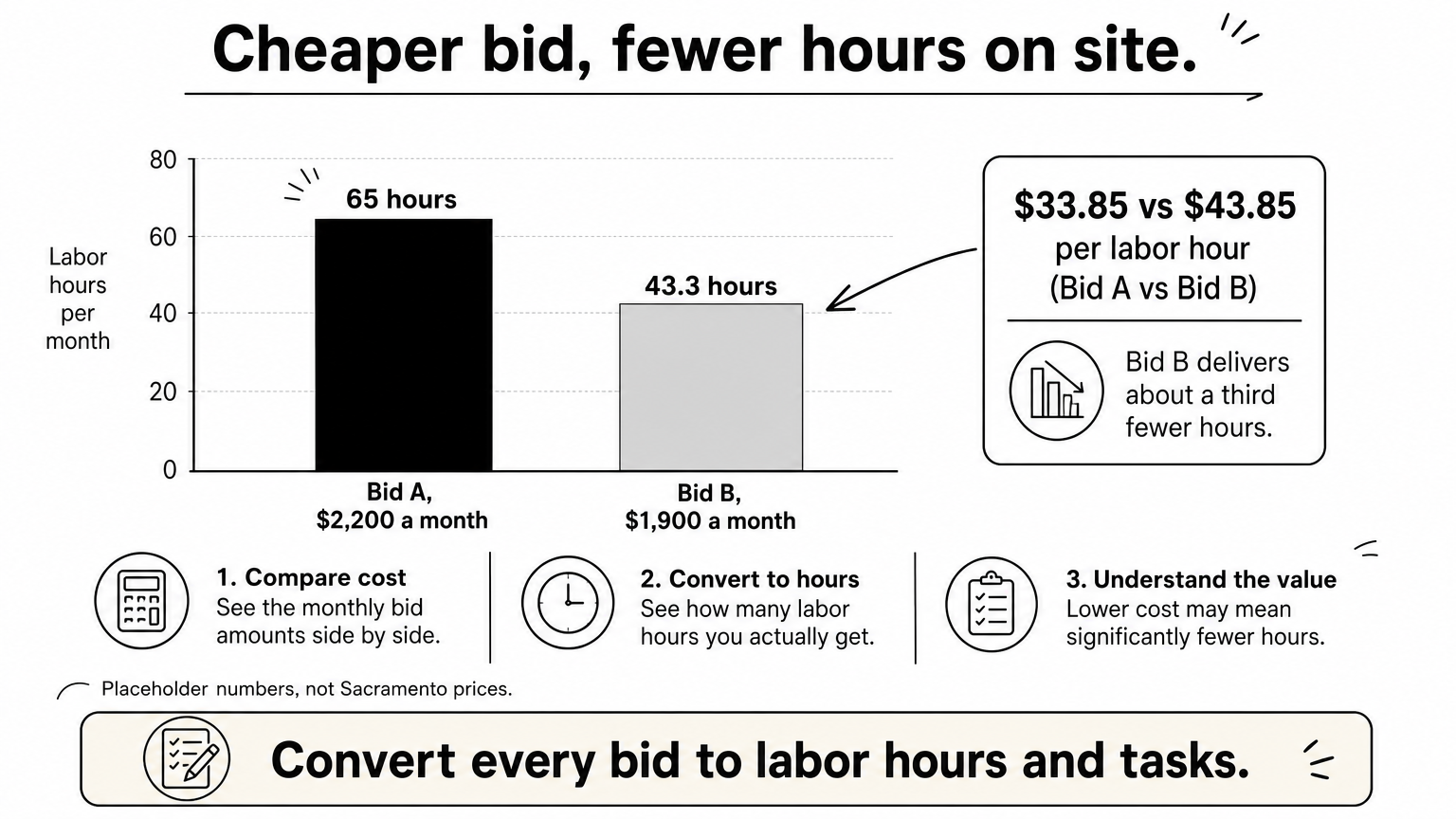
The numbers below are placeholders to show the math, not Sacramento prices. Assume a 6,000 square foot office cleaned five nights a week, which is about 21.67 visits a month (5 visits x 52 weeks / 12 months).
| Bid A | Bid B | |
|---|---|---|
| Monthly price | $2,200 | $1,900 |
| Crew per visit | 2 cleaners x 1.5 hours = 3 labor hours | 1 cleaner x 2 hours = 2 labor hours |
| Labor hours per month | 3 x 21.67 = 65 | 2 x 21.67 = 43.3 |
| Price per labor hour | $2,200 / 65 = $33.85 | $1,900 / 43.3 = $43.85 |
| Price per sq ft per month | $0.37 | $0.32 |
Bid B looks $300 cheaper, but it delivers about a third fewer hours on site (43.3 versus 65) and costs roughly $10 more per labor hour. Either the crew will skip tasks, or the company carries more margin. Bid A is the better value if both bids list the same tasks. If Bid B lists fewer tasks, it is a smaller job at a higher unit price.
Send the same request to everyone
Use this email as a starting point. It forces every bidder to answer the same questions.
 Subject: Quote request, office cleaning at [address]

Hello,

We are looking for a commercial office cleaning provider for the
facility described in the attached scope sheet. Please include in your
written quote:

1. Itemized tasks for each visit, weekly, and periodic
2. Labor hours and number of cleaners per visit
3. Visits per month and proposed service days
4. Monthly price, plus any extra charges for floor care, windows, or supplies
5. Copies of your certificate of insurance and your state janitorial
   contractor registration
6. Contract length and cancellation terms
7. Two client references with similar facilities

We would like to schedule a walkthrough on [dates].

Thank you,
[Name, title, phone]
Red flags in a quote
A one-line quote with no task list is the most common problem. A price far below the others is the next, because cleaning is labor, and labor has a floor. Be cautious too about long contracts with heavy cancellation penalties, pressure to sign during the walkthrough, and any refusal to share insurance documents. If you want a starting point for an estimate from a local provider, Sacramento Cleaning Services LLC accepts requests through a contact form or by phone.
Convert every bid to labor hours and tasks, and the cheapest quote often stops looking cheap.
Step 4. Interview your finalists
Narrow the list to two companies and ask questions that show how each one runs a night of cleaning. Good providers answer with specifics, such as checklists, named supervisors, and documented protocols, and weak ones answer with reassurance.
Questions that separate strong providers from weak ones
The table lists questions worth asking and what a solid answer sounds like.
| Question | A solid answer |
|---|---|
| Who will clean our building, and are they your employees? | Named crew or team lead, employed by the company |
| How do you train new crew members? | A defined onboarding process plus sanitation training |
| What happens when the regular cleaner is out? | A trained backup, with notice to you |
| How do you check quality? | Written checklists, scheduled inspections, a supervisor |
| How do I report a problem and how fast do you respond? | One contact, a stated response time |
| How do you handle keys, codes, and alarms? | Logged access and a clear process if a key is lost |
| What do you use to disinfect? | Named, EPA-registered products and a stated routine |
How supervision and checklists work
Ask to see a sample checklist. Written checklists make the work visible and give you something to point to when a task is missed. The better ones are task-specific, such as restrooms, breakroom, floors, and trash, and they include a sign-off line. Some providers also perform proactive property walkthroughs to spot small issues, such as a failing door seal, a stained ceiling tile, or worn carpet at an entry, before they turn into complaints. That level of attention is worth paying for in multi-tenant buildings, where a missed detail reaches your tenants and your reputation.
Chemicals, sanitation, and facility type
Ask what the crew uses and why. Offices need standard disinfectants for high-touch surfaces and restrooms, while dental practices, outpatient clinics, and municipal facilities need documented sanitation protocols, so make sure the provider names its products and routines. Sacramento Cleaning Services LLC says its crews use EPA-approved disinfectants and eco-friendly practices. If eco-friendly cleaning matters to you or to people with sensitivities in your office, ask for the product list and safety data sheets, which providers should have on hand.
The best interview question is "show me," because a provider that has the checklists, the training, and the protocols can show them to you.
Step 5. Start with a trial and a scorecard
Sign an agreement that includes a clear start date, written scope, and a review point, then treat the first 30 days as a trial. The goal is to confirm that the service you bought is the service you are getting.
Set up the first week
A smooth start prevents most early complaints. Before the first visit, hand over keys, alarm codes, and access instructions through a documented process. Walk the building with the crew lead and point out sensitive areas, special equipment, and the places that always get complaints. Agree on where supplies are stored, who restocks paper and soap, and who to call if something goes wrong.
Use this checklist for the first week.
- Confirm service days, start and end times, and who locks up.
- Walk the building with the crew lead and review the scope sheet.
- Share any rooms, items, or equipment that are off limits.
- Agree on how you report issues, such as a phone number, an email, or a shared log.
- Inspect the building the morning after the first two visits.
Read the contract for the right terms
The agreement should repeat the written scope, list the visit schedule, state the price and what triggers extra charges, and describe how either side can end the relationship. Look for a reasonable notice period instead of a long lock-in, and check that insurance requirements and background-check commitments are in the document, not just in the sales conversation. If you are unsure about a clause, have your attorney review it before you sign.
Score the service at 30 days
Review the work against a scorecard you build from your scope sheet. Rate each area on a simple pass, partial, or miss basis, and note the date and details.
- Restrooms: clean, stocked, odor-free.
- Floors: vacuumed and mopped, no missed corners or edges.
- Trash: emptied everywhere, liners replaced.
- Breakroom: surfaces wiped, sink clear.
- High-touch points: handles, switches, and shared equipment wiped.
- Communication: issues answered within the agreed time.
- Reliability: crew arrived on schedule and the building was secured.
Share the results with your provider at the 30-day review. A professional company will treat that feedback as useful, adjust the checklist, and follow up. If the same misses repeat after you raised them, that is your answer, and you can use your contract's notice terms to move on.
Hiring does not end at signature, because the 30-day review is where you find out whether the quote was real.
Ready to hire with confidence
Hiring a commercial office cleaning service comes down to preparation. Write the scope, verify the credentials, compare quotes by labor hours and tasks, ask for proof of how the crew works, and review the results after a month. Each step removes a common way these contracts fail, and together they leave you with a provider you can hold to a standard.
If you manage an office, clinic, municipal building, or business park in the Sacramento area and want a local provider to bid on your scope sheet, you can request an estimate from Sacramento Cleaning Services LLC and compare it with the others on your list.